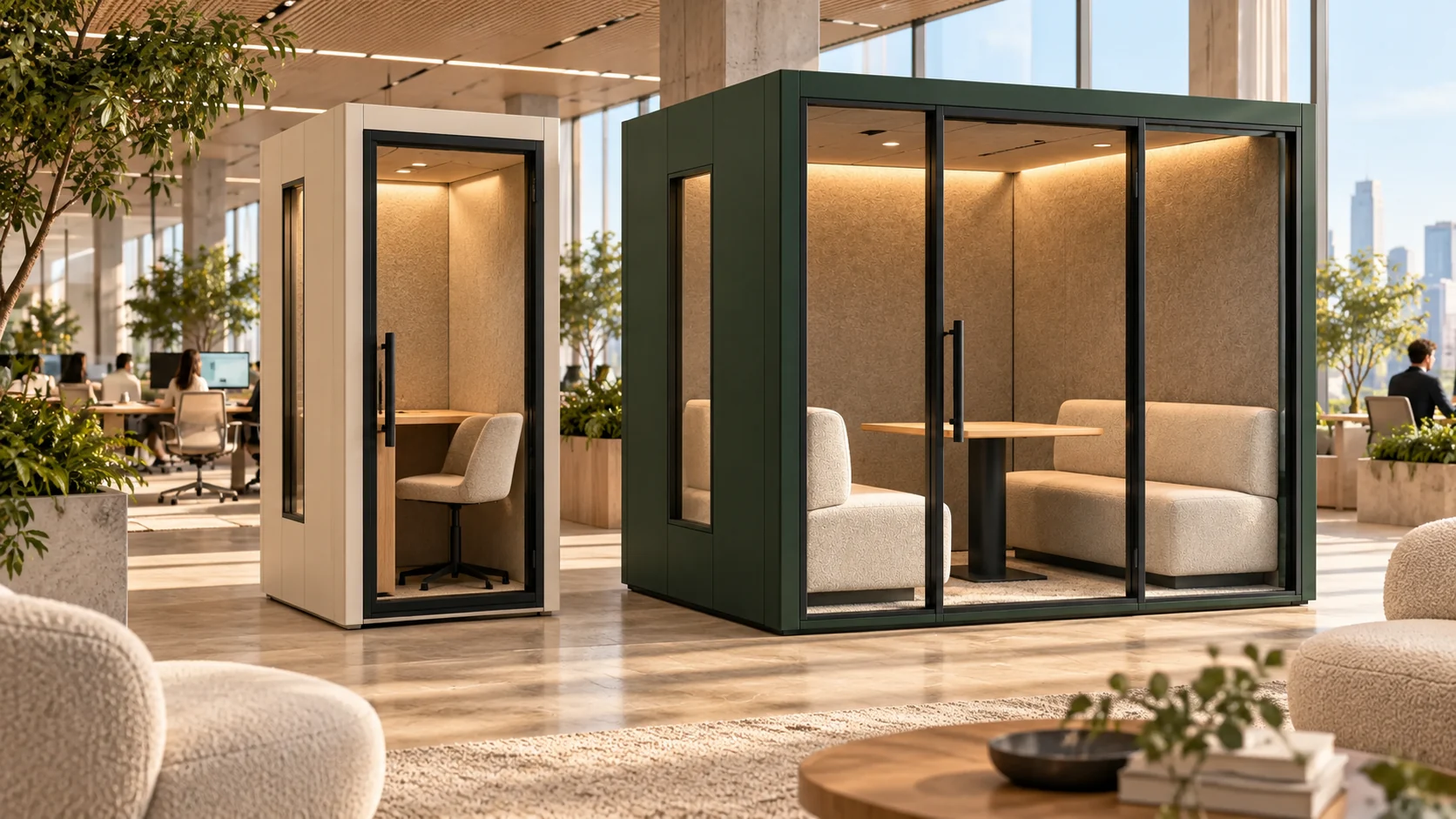
Key points
- Survey the complete route, not only the room where the pod will stand.
- Separate the product envelope from working and service clearances.
- Agree on responsibilities and handover evidence before booking delivery.
Start with a coordinated location drawing
Show the proposed pod position on the room plan and identify nearby doors, furniture, circulation routes and building services. Use the preliminary concept envelope only while exploring options. Before approving the location, obtain the selected model’s current dimensions, door movement, installation allowances and service access requirements. Record the drawing revision on which the site review is based. A drawing that is technically correct for an earlier configuration may no longer describe the package that has been ordered.
Follow the whole delivery route
Trace the route from the receiving point to the final location. Record loading arrangements, door openings, corridors, corners, lifts and changes in level. Ask the supplier for the size, mass, handling requirements and sequence of the actual delivery packages. The dimensions of an assembled pod do not establish whether its components can be delivered through a building. Share photographs and measured constraints early so that the delivery team can evaluate access rather than encountering a surprise on the installation day.
Reserve space for the work itself
The finished footprint is only part of the space needed. Ask the installer to identify areas for staging components, carrying out assembly, using equipment and moving packaging away. Establish how the work area will be separated from occupied workplace activities. Do not invent a universal clearance around every pod: use the selected manufacturer’s instructions and the installer’s method. Put the agreed requirements on the programme and site drawing so they can be protected while other work proceeds.
Resolve building interfaces before mobilization
Identify who will review power, ventilation interactions, fire-safety provisions, accessibility and any other conditions relevant to the selected product and location. UL Solutions’ guidance highlights that enclosed privacy booths can involve electrical, egress and fire-safety considerations. It also points to consultation with local code authorities. The project team should confirm applicable requirements for its site; neither a concept image nor a general product description replaces that review.
Give each interface an owner
A short responsibility schedule can prevent gaps between the supplier, installer, building manager and customer. Identify who books receiving and lift access, prepares the area, provides any required services, checks readiness and authorizes the work to begin. Confirm working hours, notification requirements and the process for handling a delivery that cannot be accepted. Include an escalation contact for each organization. The purpose is to make decisions visible before a time-sensitive delivery depends on them.
Close the project with a usable handover
At completion, reconcile the delivered configuration with the approved documents and record any outstanding items. Collect care instructions, operating information, warranty terms and service contacts. Agree on who will maintain ventilation components, review seals and glazing, manage furniture and report faults, using the manufacturer’s guidance. A handover package should be useful to the facilities team after the installation team leaves. Record its location and assign responsibility for keeping it current when the pod is serviced or changed.
Use this in your next project
Discussion checklist
- Obtain the approved location plan and current model drawings.
- Measure and document the complete delivery route.
- Confirm package sizes, weights and handling requirements.
- Reserve staging, assembly and waste-removal space.
- Assign owners for power and building-interface reviews.
- Confirm access bookings, work hours and escalation contacts.
- Collect acceptance, operating, care and warranty records.
Technical references
These sources provide background for the cited points. They do not certify the ModulPods concept collection or establish approval for a particular installation.
About this collection
ModulPods is a concept collection. Final products, specifications and suitability are confirmed for each project. The planning articles are conversation starters, not technical approvals.